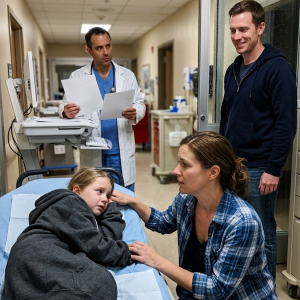
you to wait outside until I finish speaking with Brooke.”
“No,” Diane whispered.
“No, I need to—”
Dorothy stood.
It was not dramatic.
She simply rose to her full height and faced her daughter with the kind of stillness that had once silenced operating rooms.
“You will wait,” Dorothy said.
Diane’s mouth trembled.
“Mom…”
“You will wait.”
Something in Dorothy’s voice reached farther than anger.
Diane backed away.
Lena interviewed Brooke carefully.
Dates.
Prior incidents.
Specific behaviors.
Threats.
Was there ever restriction of food, movement, or communication? Did Marcus monitor the phone? Had he ever touched her neck? Had he ever entered her room at night? Brooke answered every question.
Sometimes her voice shook.
Sometimes it didn’t.
Dorothy stayed silent unless Brooke looked at her for grounding, and then Dorothy nodded once.
When Lena finished, James stepped in with preliminary reads from radiology.
“There are signs of a healing rib injury,” he said quietly.
“Older.
Weeks old, maybe more.
Could be accidental.
Could also be blunt-force trauma.
There’s also a previous hairline injury at the ulna that likely went untreated.”
Dorothy felt something inside her turn from fear into resolve.
This was no longer intuition.
It was pattern.
CPS was contacted.
So was law enforcement.
Because Brooke was sixteen, still a minor, the process moved faster than it might have otherwise.
A sheriff’s deputy assigned to hospital response arrived first, followed by a county investigator and a child protection caseworker.
Marcus, meanwhile, did what men like Marcus often did when they sensed control slipping.
He performed reasonableness.
He sat upright in the waiting area, legs apart, voice calm, concern visible, all the right questions ready.
How bad is the fracture? Why is this taking so long? Is my stepdaughter frightened? Can I see her? I just want to support my family.
Security observed him.
Patricia observed him.
Dorothy observed him from the end of the corridor for a full minute before stepping into his line of sight.
He stood when he saw her.
Marcus Webb was tall, handsome in a blunt way, with the kind of face that photographed well and believed that counted as character.
Dorothy had met him enough times to know his patterns.
He over-enunciated around educated people.
He called women emotional when he was losing ground.
He liked to place a hand on Diane’s back in public as if affection and possession were interchangeable.
“Dorothy,” he said.
“This whole thing is getting blown out of proportion.”
“Sit down,” Dorothy replied.
He smiled without warmth.
“I beg your pardon?”
“I said sit down.”
He remained standing.
The deputy took one step closer.
Marcus noticed.
So did Dorothy.
It was the first time she saw caution pass through his eyes.
“She fell,” he said.
“Diane saw it.”
“Diane repeated what you instructed her to repeat,” Dorothy said.
His expression hardened.
“That’s a serious accusation.”
“Yes,” Dorothy said.
“So is what you did to my granddaughter.”
He laughed softly, looking around for an audience who might reassure him that this was all absurd.
Nobody did.
“You can’t just decide something because you don’t like me.”
Dorothy reached into her jacket pocket and removed her phone.
“I didn’t decide tonight,” she said.
She opened the note file and scrolled.
Forty-one entries.
Dates.
Observations.
Photos of bruises Brooke had once let