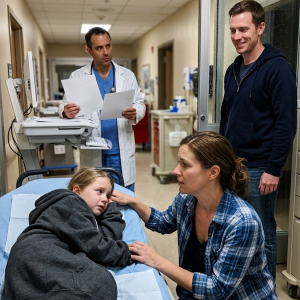
her shoulders dropped in relief so raw Dorothy felt it in her own throat.
“I’m here,” Dorothy said, sitting beside her instead of standing over her.
“I knew you’d come.”
“Of course I came.”
Brooke looked toward the curtain.
“He kept trying to come back in.”
“He won’t.” Dorothy kept her voice level.
“That curtain is closed.
It stays closed unless I say otherwise.”
Brooke nodded once.
Dorothy waited.
She had learned long ago that frightened patients told the truth best when the room stopped demanding performance from them.
“What happened?” she asked.
Brooke answered in fragments that gradually built into a clean line.
Marcus had come home angry.
The kind of angry that turned every object in a room into potential proof that someone else was disrespecting him.
Dinner had started late.
He criticized the way Brooke set down a glass.
Asked if she rolled her eyes.
She said no.
He told her not to lie to him in his house.
And she said, “It’s my house too.”
Dorothy closed her hand over her own knee.
That would have been enough.
Marcus followed Brooke into the hallway.
Diane came out of the bedroom.
Marcus grabbed Brooke’s wrist.
She pulled.
He caught her forearm.
Twisted.
Brooke heard a crack before the pain fully hit.
Diane said, “Marcus, stop,” but too late and too softly.
Then, according to Brooke, Marcus did what controlling men often did best: he switched from violence to administration.
You fell.
You slipped by the stairs.
Your mother saw you.
Do you understand?
He gave instructions all the way to the hospital.
Diane stared through the windshield and never turned around.
“Has he hurt you before?” Dorothy asked.
“Yes.”
“How many times?”
Brooke swallowed.
“I don’t know.
Maybe seven.
Maybe more if you count things that didn’t bruise.”
The room seemed to narrow around that sentence.
“Has anyone ever asked you about it?” Dorothy said.
“My school counselor.
Once.
I shut it down.”
Dorothy nodded.
“Tonight you don’t shut it down.”
Brooke looked at her, frightened and exhausted.
“What happens now?”
“Now,” Dorothy said, “the truth becomes paperwork, and paperwork becomes people he cannot control.”
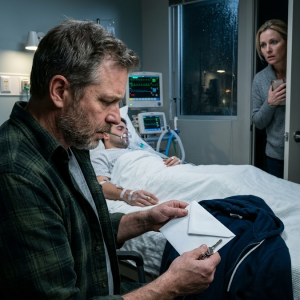
A few minutes later, the social worker arrived.
Her name was Lena Ortiz.
She was in her forties, brisk without being cold, carrying a legal pad and a manila envelope from Brooke’s school that had been faxed over after Patricia called the after-hours line for student support records.
“I spoke with the on-call school administrator,” Lena said quietly.
“Your counselor documented concerns.”
Brooke stiffened.
Lena opened the envelope and removed several pages.
The first was a dated statement Brooke had written during a private counseling session six weeks earlier but had refused to sign for outside reporting after breaking down in the office.
The counselor had followed protocol, documented concern, and because Brooke recanted before a direct allegation could be confirmed, the matter had remained internal pending further signs.
Across the top, in Brooke’s handwriting, were the words: I don’t think my mom will choose me if she has to choose.
Diane made a noise in the hallway.
Dorothy looked up.
Her daughter stood just outside the curtain, face drained white, one hand against the wall as if the building itself had shifted under her.
Lena turned.
“Ma’am, I need to ask