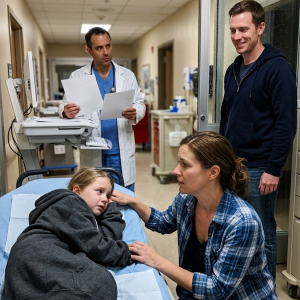
her take under the pretense of checking for infection.
Screenshots of messages.
Notes about canceled visits after arguments at home.
The exact wording of strange things Marcus had said at family gatherings.
Brooke’s weight loss across winter.
Diane’s insistence that everything was fine.
Brooke’s tendency to flinch whenever a man crossed behind her unexpectedly.
Marcus’s smile thinned.
Dorothy did not hand him the phone.
She simply let him see enough to realize this had not begun tonight.
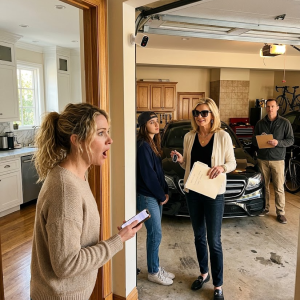
Then Diane arrived.
Dorothy turned and nearly failed to recognize her own daughter.
Diane’s face had caved inward somehow, as though years of compromise were suddenly visible from the outside.
Her eyes were swollen, not from dramatic sobbing but from the kind of crying that happens alone in bathrooms while the faucet is running.
“Mom,” Diane said, voice frayed, “I need to speak to Brooke.”
“No,” Lena said from behind Dorothy.
“Not until I finish.”
Diane looked at Marcus.
He gave her the smallest shake of his head, a motion so practiced it might have passed unnoticed to anyone else.
Dorothy saw it.
So did the deputy.
“Mrs.
Webb,” the deputy said, “I need a statement from you separately.”
Marcus spoke over him.
“She’s upset.
She needs a minute.”
The deputy did not look at Marcus.
“Mrs.
Webb.”
Diane stared at the floor.
“What did you see tonight?” Lena asked.
A silence opened.
Not an ordinary pause.
A cliff.
Dorothy knew her daughter well enough to recognize the war happening behind her face.
Shame.
Fear.
Habit.
Loyalty.
Dependency.
Denial.
Love twisted into something weaker and dirtier than itself.
Diane had spent years turning down the volume on what she knew because admitting it would require action, and action would require admitting what she had exposed her daughter to.
Marcus spoke again, gentler this time.
“Baby, just tell them what happened.”
Diane lifted her eyes.
Dorothy saw it then—the first clean flicker of horror directed not at Brooke, not at herself, but at him.
“No,” Diane said.
Marcus blinked.
“What?”
“No,” she said again, louder.
Her voice cracked, but it did not disappear.
“I didn’t see her fall.”
Everything changed in that second.
Marcus straightened.
“Diane.”
“She didn’t fall,” Diane said, words tumbling now as if a locked door had finally burst open.
“You grabbed her.
You twisted her arm.
I heard it.”
Marcus’s face emptied out, the performance gone.
“Watch yourself.”
The deputy moved between him and Diane.
“I told myself it wasn’t that bad before,” Diane said, crying openly now.
“I told myself you were stressed, or angry, or you didn’t mean it.
I told myself if I kept things calm, you’d stop.
I told myself she was dramatic.
I told myself…”
Her breath hitched.
“I told myself lies because I was afraid of being alone again.”
Brooke had gone very still inside the bay.
Dorothy did not turn to look at her yet.
Some moments belonged to the people standing in them.
Marcus tried one more pivot.
“You are not in your right mind.
She’s turning you against me.”
Dorothy had heard enough.
“No,” she said.
“The record is turning against you.
The fracture is turning against you.
The hospital staff is turning against you.
Her counselor’s notes are turning against you.
And for the first time in a long while,